


Housing, Immigration
ICE raided a housing complex in South Side Chicago. Its residents are seeking accountability from the federal government
Table of contents
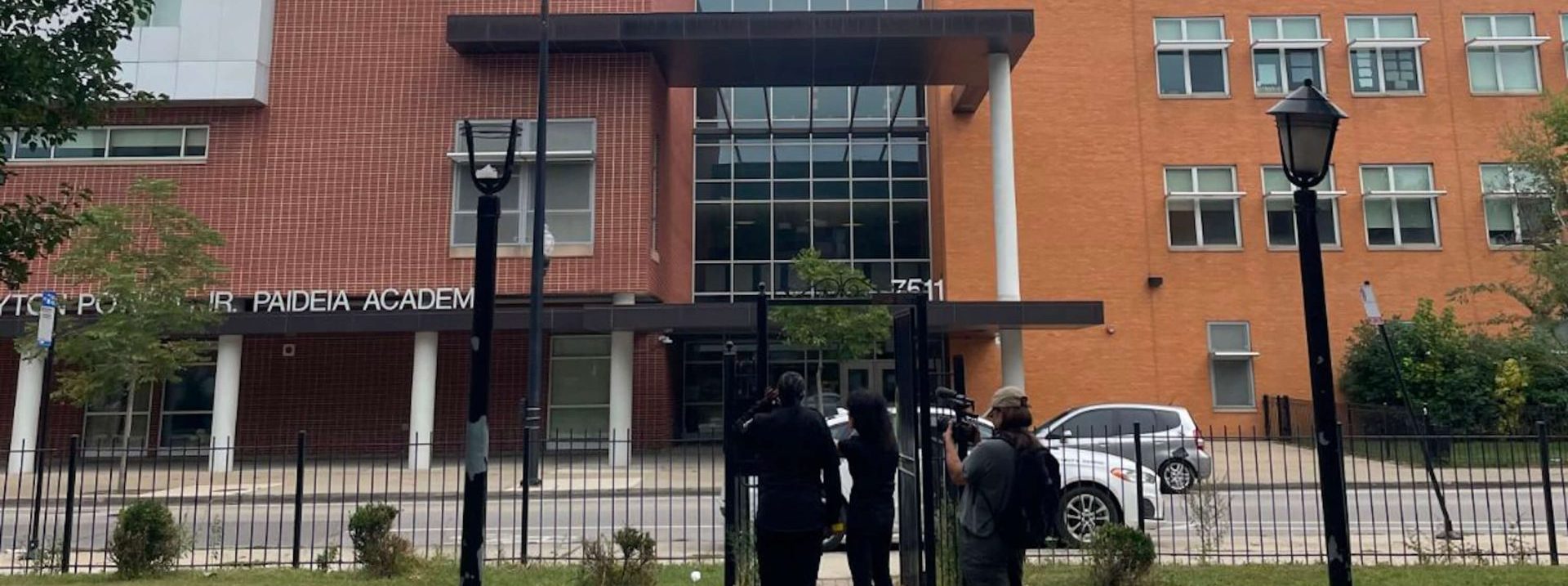
One year after federal agents descended on a southside Chicago apartment building – unleashing chaos for hundreds of unsuspecting residents after claiming criminal gang members were running the property– the complex now sits empty. The courtyard at 7500 South Shore is overgrown with weeds. Windows near the street are boarded up. Shattered glass still litters a few windows on the higher floors.
Earlier this year, lawyers representing 18 former residents of the building announced they filed a federal tort claim against the U.S. government. They argue that federal agents violated their clients’ civil rights during the raid, that the government failed to provide warrants to enter their property, and that the agents’ actions while in the function of their jobs led to physical and psychological harm.
“One of our clients describes having nightmares of officers saying, ‘I’m going to kill you. Get down or I’ll kill you’,” said Jonathan Manes, one of the attorneys representing the former residents. “That kind of indignity sticks with people.”
The lasting structural damage at 7500 South Shore Drive points to the havoc that unfolded on September 30, 2025. And the impact it had on the residents present that night.
Nearly 300 federal agents from multiple agencies — including the Department of Homeland Security, ICE and the FBI — raided this multi-family building in the middle of the night. Agents rappelled down onto the building as Black Hawk military helicopters flew overhead. They used flash-bang grenades and, according to witnesses, in some cases forced entry into apartments at gunpoint. Many of the building’s residents were U.S. citizens.
A professional film crew that accompanied the federal government recorded much of the raid. The Department of Homeland Security later edited footage from that night into a short promotional reel resembling a Hollywood action trailer and posted it on the agency’s X account just a few days later.
That night, authorities detained 37 people. The federal government claims the raid was conducted to arrest suspected members of the Venezuelan gang “Tren de Aragua.” Recent reporting by Futuro Investigates highlighted a similar situation in Aurora, Colorado. In both cities, the focus is an apartment complex owned by someone who doesn’t live there. After the complex fell into deep disrepair, it was rented out to newly arrived Venezuelan asylum seekers. This was followed by accusations that “Tren De Aragua” had taken over the complex. It, too, culminated in a massive immigration raid.
In Chicago, to this day, participating federal agencies have not yet proven through criminal convictions that any members of this criminal organization were arrested that night at 7500 South Shore.
Neither have criminal charges been filed against any of the agents that participated in the raid, despite an investigation by the state of Illinois into this and other events that took place over several months as part of “Operation Midway Blitz,” despite calls for accountability from local elected officials.
Seeking Accountability
The former residents pursuing the administrative claim against the U.S. The Department of Homeland Security and other federal agencies are represented by attorneys from the MacArthur Justice Center, the National Immigration Law Center, and several partner organizations.
Manes, senior counsel at MacArthur, says they are seeking accountability for what he describes as militarized violence by federal immigration authorities.
“The level of militarized violence that we’ve seen from federal immigration authorities on our streets is shocking and it demands accountability,” Manes said.
However, taking legal action against federal officers presents significant obstacles.
“ A lot of our work in the past was focused on accountability for abuses at the state and local level. And there are tools available there that just are not available against the federal government,” Manes said. “A lot of people don’t realize that you can’t really sue a federal officer for violating your constitutional rights directly.”
Unlike state and local officers, federal law enforcement agents are not subject to the same general statutory route for civil-rights lawsuits. Individual agents can theoretically be charged under criminal state laws, but they could have certain immunity if their actions are considered proper in carrying out their federal duties. This, along with other legal rulings, makes this a complicated avenue to pursue.
Manes said his team also struggled to identify the individual officers involved in the raid.
“In ordinary police work, that’s public,” Manes said. “You get a police report, you see who arrested your client, you see what happened.”
Instead, the attorneys filed a claim against the federal agencies under the Federal Tort Claims Act, a law that permits certain claims for personal injury or property damage against the government for damages caused by federal employees.
The administrative claim gives the government an opportunity to investigate and choose to resolve or deny the allegations. If the government doesn’t respond or denies the claim, claimants could pursue a lawsuit.
Residents Speak Out
Statements submitted as part of the tort claim describe targeting based on race, agents breaking down apartment doors, pointing weapons at families, and removing residents without warrants.
One woman said agents forced their way into her apartment and ordered her family outside at gunpoint. She says her six-year-old son was marched outside in only his underwear.
Another claimant describes waking up in bed to loud bangs. Before he knew what was happening, he says officers entered the room and released a K-9. He says the dog bit him, and describes being zip-tied while bleeding profusely.
Another statement describes being struck on the head with a rifle. The claimant says he was detained for two months and although he’d previously had heart surgery, he was denied necessary medication.
Accounts from families and former residents, including at least one U.S. citizen, describe similar interactions. They all deny criminal involvement and say they were not shown warrants. Documents say they hope to hold the government accountable so this doesn’t happen again.
The former residents who filed the claim declined to give interviews for this story.
Questions About How and Why The Raid Happened
Federal officials portrayed the operation as an effort to target Tren de Aragua, a Venezuelan criminal organization often cited in President Trump’s campaign rhetoric.
“How about you live in the apartment next door to Tren de Aragua members that are trafficking in prostitution, guns, drugs, and taking advantage of American citizens in a violent way,” said former Border Patrol Chief Greg Bovino to a news reporter at that time. “Why don’t you live next to them and then see how much of a Gestapo or a Nazi we are?”
The government did not provide evidence to back up these claims.
Reporting after the raid has not been able to confirm arrests of wanted criminals or claims that the building was “overrun” by Tren de Aragua gang members.
What is clear is that the raid of 7500 South Shore took place against the backdrop of a deteriorating apartment complex with a troubled history. The property was among three buildings acquired by Wisconsin-based investor Trinity Flood in 2020. Tenants reported mounting maintenance and security concerns. By the time the raid occurred, records show the owner had spent months in court over growing housing-code violations and other financial issues.
After the raid, local investigative reporting lent weight to rumors that the property owner or management may have potentially coordinated with federal enforcement. The Illinois Department of Human Rights then opened an investigation into potential housing discrimination. That investigation is ongoing.
Jonathan Manes, the lawyer representing claimants, said he has little faith in internal government accountability measures but still believes that courts can help his clients recover from the traumatic night and hold the government accountable.
“They claimed they were raiding this building because it was full of Tren de Aragua gang members,” said Manes. “And yet, in the nearly a year since, there has been zero evidence that anybody in that building was affiliated with Tren de Aragua. It was a pretext for a militarized raid that was meant to frighten people.”
He says many of the former residents he represents are still living in fear.
For South Shore residents, the question is whether the legal system can provide meaningful scrutiny of a federal operation with little transparency that left countless people displaced and frightened.
Just a few weeks ago, almost exactly one year to the day of the South Shore raid, the Department of Homeland Security announced plans for a new so-called “ICE surge.”
“ Sanctuary cities are sanctuaries for criminals, they need to be outlawed,” said Tom Homan, the border czar of the Trump administration, at a Department of Justice event at the end of September. “We’re going to keep pushing. We’re not gonna apologize. We’re not going anywhere.”
The results of the battle for accountability in this South Shore neighborhood feel especially important as time passes, and as Chicago residents and people in cities across the country face the possibility of another influx of federal agents and more raids.
This article was published in partnership with La Voz and La Raza.
Banner photo: Maria, Cindy and Anderson en un edificio de apartamentos en el sur de Chicago. Photo by Julieta Martinelli for Futuro Investigates.
Credits
REPORTERS
PRODUCERS
ADDITIONAL PRODUCTION
EDITOR
EDITORIAL SUPPORT
EXECUTIVE PRODUCERS
FACT-CHECKING & TRANSLATION
SOUND ENGINEERS
SOCIAL MEDIA
PRODUCTION MANAGER
RELATED STORIES YOU MIGHT LIKE