


Humanity, Immigration, Reporter’s Notebook
Estrella: a source and journalist, a tattoo and how covering her story for a decade changed me
Some stories and sources change your life. Then there are sources who become a part of your life. And you, the journalist, can change their lives too.
Not every source is life-changing. Those of us who have covered daily breaking news know what that’s like. Sometimes, journalists report without deep connections to the people they cover. It becomes too impersonal. But a good journalist lets a source impact them, and yes, even change them. I believe in and practice journalism with heart, so why wouldn’t I keep my heart open to the people I report on?
Not just reporting
When I first met Estrella, she was the subject of my reporting, a Mexican trans woman arrested when she was trying to get a restraining order against her abusive partner in Texas. She was the first person we knew of being taken from a courtroom. This was breaking news. I traveled to jail to meet her, as I would for any other source, but from the beginning I could tell this would be different.
That first time, she came in shackled; chains bound her waist, hands, legs, and ankles. Her sadness was so embodied in her. Defeat in her eyes. The only thing that defined her as the woman she was: a stringy purple ponytail.
The shackles came off after I asked the corrections officer to let her be free in our presence. He only took them off her hands. I was suddenly enthralled. Estrella became larger than life just with her hands. The way she told her life’s stories. How she caressed her own face, even though she knew I could see the stubble. She was so ashamed of that.
For over a decade, since that first meeting, she and I spoke hundreds of times on the phone, and I visited her seven times while she was incarcerated in Texas. Twice during those nine years, the Texas Department of Corrections banned me from seeing or writing to her. The authorities there said I broke some rules but never proved it.
Over the years, the phone calls became more intense. Sometimes, she said, it felt like I was living with her inside that prison. Other times, she said, she felt free when she heard the outside world through the phone: the beach in Punta Cana, the streets of Spanish Harlem, Rome, a reporting trip to El Salvador… It was like she was with me.
Estrella changing me
Estrella was surprised too by how our relationship evolved. She didn’t expect to become so connected to a journalist, just like I never expected to become so rooted to a source.
Yes, the phone calls were mostly about documenting the life she was living in prison, but soon they became fun. We talked about our exercise routines. She was busy transforming her body into the woman she always was, becoming free from the male body she was born with, a body she felt trapped in. Meanwhile, I was busy keeping my body young and strong. We talked about makeup, fashion, and her extravagant cooking inside the prison, like when she made tamales from crushed, moistened Dorito chips. And then there were moments of darkness, like when Estrella revealed to me that she had been assaulted and raped by her cellmate, but she refused to report it to her jailers.
I was there, on the phone, to hear how it was when she was put into solitary confinement, into segregation and the cells were freezing cold or so hot she could barely breathe.
At one point, in those moments of desperation, Estrella made a commitment to herself that she didn’t reveal to me until years later. She would stay happy and hopeful, no matter how much her circumstances forced her to live in despair.
On one of my visits, she told me she had a gift for me. I knew that was impossible since she was behind bars and could not give me anything. That day I visited her with a camera crew. She looked in my eyes and told me she was going to give me the gift, but I could not react. Then she showed me the inside of her left wrist. There she had tattooed my name in script on her body.
Honestly, I was horrified. This was too much. But then Estrella explained that, in her moments of solitude, she would put her left arm up to her heart and feel me close, which gave her strength. I understood, even though I knew a line had been crossed, a line defined by the more traditional way we have been told a journalist and a source should interact.
Then something unexpected happened: my son joined me as a producer on one of the prison visits. He met the Puerto Rican videographer we hired in Dallas to join us on the trip. While we drove two hours to Wichita Falls and I napped in the backseat, the videographer and my son fell in love. They’re getting married in less than a month. Thanks to Estrella, my son met the love of his life.
A new life
Now Estrella is out of prison. She was sentenced after her abusive partner drugged her to commit fraud. She spent nine years in prison for a non-violent conviction. Then, almost immediately, she was deported to Mexico without due process shortly after serving her sentence in Texas.
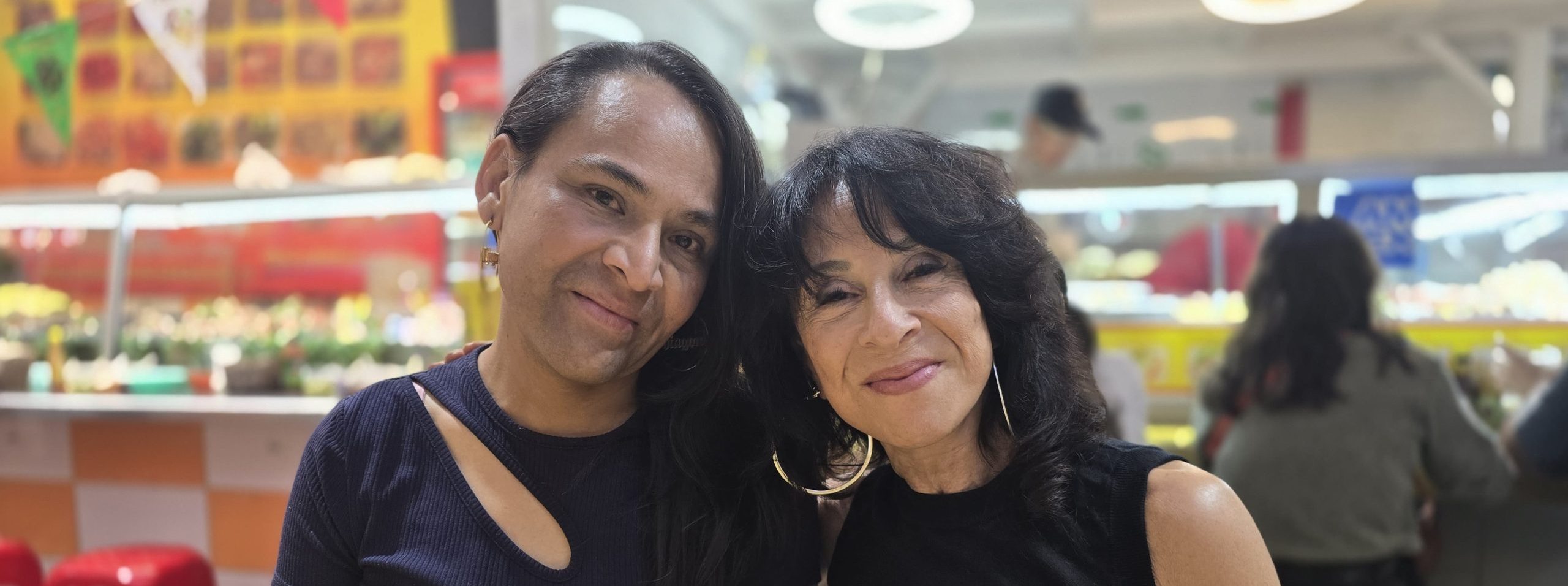
We met in Mexico City shortly after she was deported. Now she lives in Tijuana. Our phone calls have become freer-flowing. Now, woman to woman, we are becoming friends, laughing off the record and sharing fun secrets we never would on a prison-tapped phone call. These days we talk about love. I tell her she is a romantic existentialist and has taught me how to live that way. Yes, Estrella has helped me fall even deeper in love with my husband. That’s because when you speak to someone behind bars who can’t express their love freely, you want to be more present in the love you can give.
Estrella was deported from the United States without ever seeing a judge. Her lawyers say this lacked due process, because some of her legal paths to remain in the US are still pending. She left Mexico as a gay man, escaping from the homophobic violence in Guerrero, where she was born and raised. She now returns as a trans woman, traumatized by the decade she spent behind bars and by the months she has been trying to find her way as a free trans woman in Mexico, a country that has never known her as such.
It is a rare honor for journalists to be given an exclusive to an incredible, historic source like Estrella. And I could not be more grateful that this source got into my heart and changed me.
Estrella has helped me become a better person—someone who understands the trans experience better than I did a decade ago, someone who has learned not to be judgmental, someone who listens, and listens with her heart, just like Estrella does for me.
Credits
REPORTERS & PRODUCERS
ADDITIONAL PRODUCTION
EDITOR & MANAGING EDITOR
EDITORIAL SUPPORT
EXECUTIVE PRODUCERS
FACT-CHECKING
TRANSLATION
SOUND ENGINEERS
SOCIAL MEDIA
PRODUCTION MANAGER
RELATED STORIES YOU MIGHT LIKE