


Border, Humanity
Five Days in Palestina
When Anthony Harb first took up a Spanish language course in college, he never imagined it would lead him to the steps of Al Aqsa mosque in Jerusalem, just 10 miles from where his parents were born.
Harb is Palestinian-American and grew up speaking Arabic at home in Chicago. But when he considered studying the language formally in college, his professor discouraged him, telling him he would have a hard time as a heritage speaker. Deterred, Harb decided to pursue a degree in Spanish language studies instead. He was thinking about how Latino heritage speakers might have gone through a similar experience.
“ I’m doing this because I wanna be a good Spanish teacher,” Harb said. “And I wanna be able to help Latines learn better Spanish, so that they can feel better about their Latinidad.”
Harb is now a professor of communication based in California, where he focuses on Spanish linguistics. During his research, he began making connections between the undocumented Latino immigrant experience in the United States and the Palestinian experience back home.
It’s because of this work that Harb was able to visit his homeland in Palestine for the first time in his life. He was invited, along with about 10 other students and professors from the United States, to take part in an exchange with Palestinian academics in the occupied West Bank. Over the course of roughly one week, they would connect with their Palestinian peers to learn about what life is like for Palestinians who have been living under Israeli military control for decades.
“ I got to come home because I learned Spanish,” he said.
In early February, Latino USA traveled to the occupied West Bank to document the delegation and to understand more about what drives the solidarity between Latinos and Palestinians.
_______________________________________________________________
Why many Latino activists organize for Palestine
Latino-led immigrant rights groups have long participated in pro-Palestinian protests across the United States. The protest movement has especially grown since the genocide in Gaza began in October 2023, especially on U.S. campuses. After the Hamas attack on Israel on October 7th, which killed around 1,200 people, Israel launched a full scale assault across the Gaza Strip. More than 73,000 Palestinians have been killed so far, including more than 20,000 children and at least 263 journalists.
Many Latinos have drawn connections between the violence inflicted by U.S. Immigration and Customs Enforcement (ICE) and law enforcement against immigrants here in the U.S. and the violence inflicted by Israeli forces on Palestinians.
One Latina student from the delegation, who requested to remain anonymous, made the connections with her own indigenous Latin American roots.
“ My grandma grew up in indigenous communities and shared their practices,” she said. “It did have me thinking, especially seeing and starting to process so many injustices in the world, how land is really at the root of it all.”
The student was invited to participate in the delegation because of her pro-Palestine organizing at her university. But she would never make it to the West Bank with the rest of the group.
_______________________________________________________________
A troubling border experience
When the group traveled from Jordan to the occupied West Bank via the Allenby Bridge crossing, she and another student of color, were stopped and questioned by Israeli border officials. Two white students who were traveling with them were issued their entry visas immediately.
Harb, whose family is from the West Bank city of Ramallah, was also told to wait when he reached the passport counter.
The group separations signaled a long reported pattern of racial profiling by Israel at the border. The waiting area, which was made up of a few rows of chairs placed to the side of the passport counters, comprised almost entirely of people of color.
“It felt like they weren’t even trying to hide their racism or segregation,” said one of the students.
Harb waited about an hour before an Israeli official finally took him to another area to question him on why he was coming into the West Bank. Then, he says, the official asked him multiple times about participating in university protests, which Harb denied.
“I said, ‘I teach 300 students. I’m focused on grading and doing my work,’” he said.
After several other questions, the official told Harb he could get his entry visa, telling him to “ have a good time in Israel.”
Meanwhile, it would be roughly four hours before the four students were finally questioned. They were asked the same questions as Harb.
“ Did you attend any protests at your school specifically against Israel?” one of the border officials asked.
All four of the students have been suspended from their universities for participating in protests, and some have pending misdemeanor charges related to campus arrests. One official even brought this up, telling the Latina student they had proof of her arrest.
After multiple rounds of questioning and nearly seven hours waiting, the two students of color were denied entry. The other two white students stayed behind with them.
”They never showed me proof that they actually had my record of anything,” said the Latina student. “And to this day, we don’t know if they actually did or not.”
Latino USA asked the Population and Immigration Authority of Israel (PIBA) about the students’ denial and if officials have access to U.S. law enforcement records. They responded, “as a rule, the decision at the border is taken considering different parameters.” They also denied that they use racial profiling at the border.
The Latina student told Latino USA her experience reminded her of how the United States treats immigrants coming into the country.
“The security’s becoming more and more intense, and they are checking people’s social media, and it’s all to check if you’re plotting on their downfall,” she said.
_______________________________________________________________
A shared surveillance system
In fact, the United States and Israel both incorporate social media monitoring at the border. Last year, the Trump administration proposed they would check the social media history of certain visitors coming to the United States. In Israel, the government has monitored Palestinians online for years and has increased their social media surveillance since 2023.
The similarities in surveillance tactics extends beyond the digital space, too. Elbit Systems, Israel’s largest weapons manufacturer that has played a large role in the ongoing genocide in Gaza, is responsible for security technology used along the separation wall in the occupied West Bank.
Israel’s surveillance apparatus also infiltrates the US-Mexico border. At least 55 of the nearly 600 surveillance towers found along the southern border wall are made by Elbit America, one of Elbit’s subsidiaries. A multimillion dollar contract between Elbit and Customs and Border Protection (CBP) has essentially ensured more towers will be built in the next decade.
Today, Elbit is a main target of both pro-Palestine and immigrant rights activists alike, who see the parallels between how this military technology is used in Palestine and at the US-Mexico border.
_______________________________________________________________
‘We insist on living’
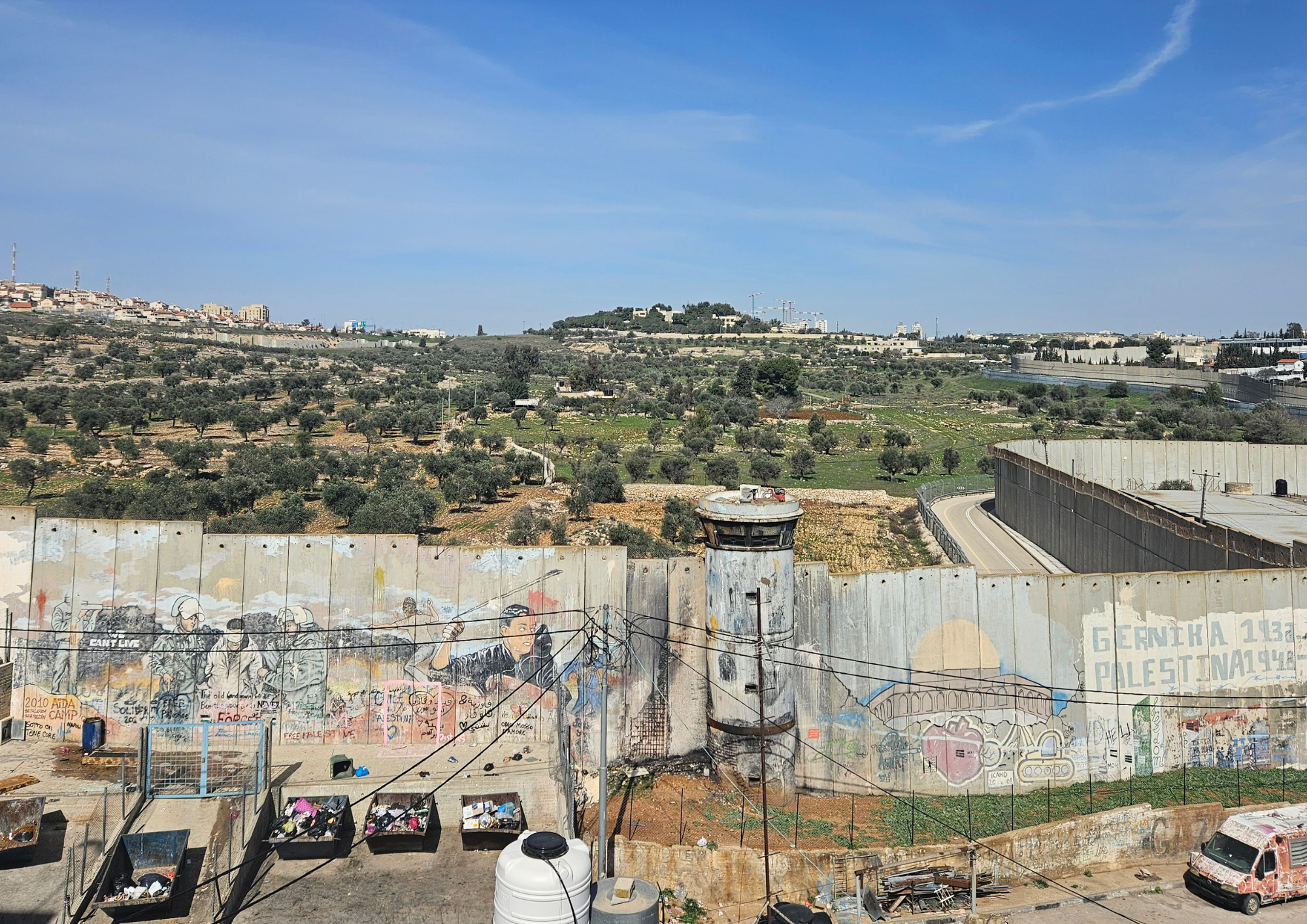
These walls, both in the occupied West Bank and at the US-Mexico border, serve as tools for keeping people out. In the West Bank, it’s also part of government policy that severely restricts freedom of movement for Palestinians.
The Palestinian members of the delegation all have West Bank IDs, which are green. These green IDs make it illegal for them to travel to Gaza and Jerusalem, unless they receive a special permit from Israel, which is rarely granted.
Even if permission is granted, they would have to cross through checkpoints. One of the largest military checkpoints is Qalandia, which sits between Ramallah and occupied East Jerusalem. Thousands of Palestinians cross it daily and the journey can often take hours.
Harb traveled through Qalandia by bus. As he got closer to the terminal, he saw Palestinians, many of them young children, stopping cars to sell them small items, like socks and tissues. He noted how spatially similar this checkpoint was to the San Diego-Tijuana border crossing.
“It’s similar in the sense that where you wait is just people standing at the border who can’t cross,” he said. “The border is full of so much commerce.”
It took him more than three hours to get to Jerusalem, which is roughly only 10 miles from Ramallah.
Harb’s observation signaled perhaps the most significant similarity between the borders in the US and in Palestine. Despite the physical barriers of walls and checkpoints controlling where people can travel, the walls don’t control how people continue to live—whether they are selling trinkets at the border or partaking in a transnational academic exchange. These forms of resistance—large and small—have become a focal point of the international solidarity movement.
Credits
Reporters
PRODUCER
Editor
Editorial Support
Managing Editor
Executive Producers
Fact-checking
Sound Engineers
Social Media
Artwork
PRODUCTION MANAGER
RELATED STORIES YOU MIGHT LIKE