



How El Salvador Incarcerates Women with Obstetric Emergencies
Table of contents
Editor’s Note: This investigation was produced by Futuro Investigates and Latino USA and co-published in partnership with El Faro English.
What does a no-exceptions abortion ban look like? We went to El Salvador, one of the countries with the most restrictive anti-abortion laws in the world, to investigate how women have been incarcerated after losing their babies.
It’s July 2007, in the capital of El Salvador. Teodora Vázquez, a 24-year-old woman, sits alone at work at the end of the day. Nine months pregnant, she suddenly goes into labor.
With no one around to help her, Teodora repeatedly calls 911 asking for an ambulance. None shows up. As her pain gets worse, she gets the urge to use the restroom. When she arrives, the lights are not working. In the dark stall, Teodora sits down and feels something dropping from inside of her.
She loses consciousness, and blood begins to pool beneath her. Eventually, someone finally arrives. But it isn’t the medical help Vázquez had been praying for. It is the police.
“They accused me of killing my daughter and they handcuffed me,” Vázquez said.
She was arrested, tried, and sentenced to 30 years in prison for losing her baby. She was not seeking an abortion. Still, for the Salvadoran authorities, Vázquez had killed her own child.
Her story isn’t uncommon in El Salvador, a country with one of the strictest abortion laws in the world.
Early this year, the Latino USA and Futuro Investigates team traveled to San Salvador. We reviewed documents, archival materials, and visited some key locations to understand the grassroots movement for abortion access in the country, and conducted interviews with activists on both sides of the debate and regular Salvadorans.
The resulting investigation paints a clear and disturbing picture of the women who suffer most when a country stretches the definition of abortion to include obstetric emergencies out of a woman’s control.
Our team also spoke with Vázquez and other women who have been incarcerated for obstetric emergencies like a miscarriage, going into labor alone and hemorrhaging, or having a stillbirth.
No exceptions
El Salvador made all abortions illegal in 1997. Two years later, in 1999, it amended its constitution to recognize the “right to life” from conception.
This means that any pregnancy that ends before the baby is born could turn a woman into a criminal. In some cases, it can lead her to an aggravated homicide charge with up to 50 years in prison.
International bodies, such as the Inter-American Commission on Human Rights, warn the law violates human rights. Still, its recommendations for a change in El Salvador have had no effect so far.
It’s a harsh reality many regular Salvadorans have come to accept and even embrace, as we saw and heard during our investigation. Medical professionals, including nurses and doctors, often summon the police when women are having a miscarriage, to avoid being prosecuted themselves. Police and judges opt not to make distinctions between a voluntary abortion and an obstetric emergency out of fear of being involved in what the government might define as a straightforward illegal abortion.
Under its no-exception abortion laws, El Salvador has prosecuted more than 180 women over the past two decades. Most of those women belong to low-income homes in rural areas of the country.
“Unfortunately, here in El Salvador, they criminalize poverty a lot,” said Arturo Castellano, a social worker with Agrupación Ciudadana por la Despenalización del Aborto (the Citizen Group for the Depenalization of Abortion).
Salvadoran women who have the means to travel outside the country to end their pregnancies or pay a private —and discreet— doctor to perform an abortion, avoid the law, Castellano said.
‘Las 17’
Castellano’s group has worked since 2009 to prove that women who are incarcerated for unintentionally losing their babies are not criminals. They argue that it’s not their fault if they do not perfectly complete their pregnancies. The Group seeks to show that, instead, the women are victims being punished for physically and emotionally painful medical emergencies.
Over the years, the advocacy Group has helped at least 73 women regain their freedom. A particular turning point in their efforts came in 2014, when they launched a campaign called “Las 17,” or The 17.
It was a reference to the 17 women who, at the time, were in prison after being wrongfully convicted to up to 40 years for reporting an obstetric emergency, a miscarriage, or a stillbirth.
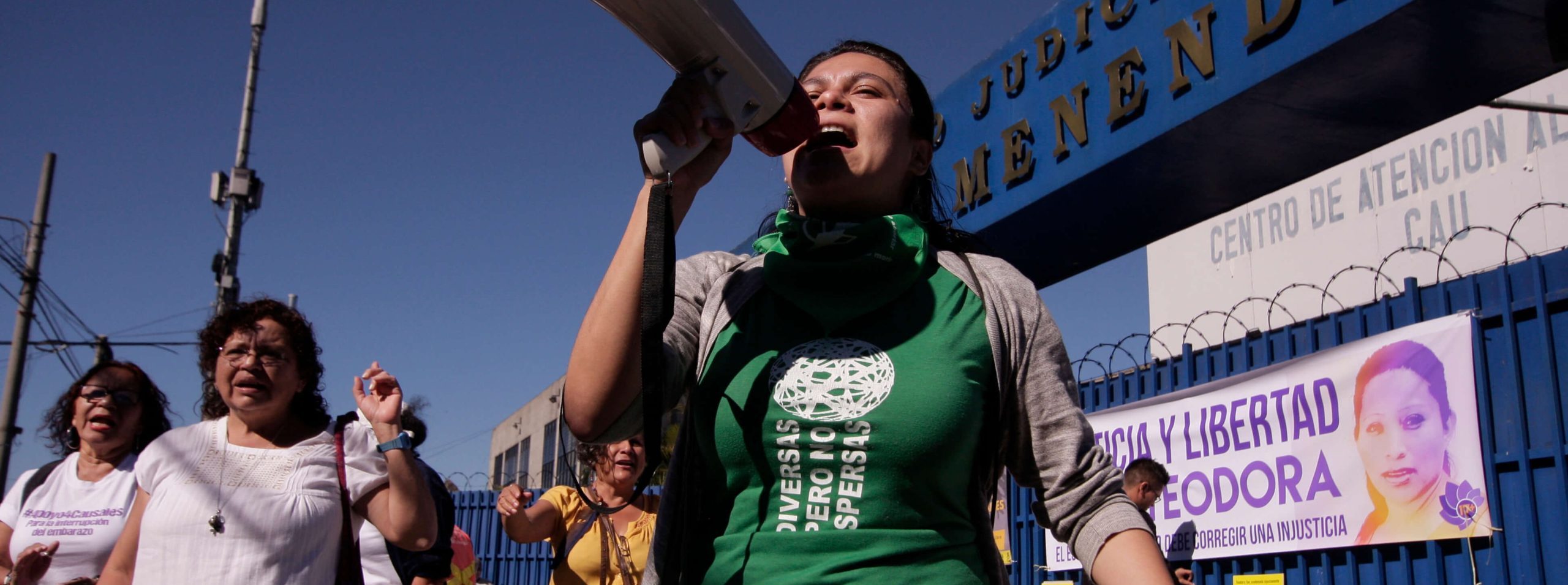
Vázquez, the woman who lost her baby after hemorrhaging at work alone when her calls to 911 went unanswered, became the face of the group’s campaign.
The activists’ goal was to obtain the pardon of the 17 women, an effort that would take over the debate about abortion inside El Salvador.
Local antiabortion activists responded by joining forces with the U.S.-based NGO Alliance Defending Freedom, which was a big player in the legal strategy that led to the successful fall of Roe v. Wade in 2022.
Together, they pushed for new lawyers to join the anti-abortion cause in El Salvador, to make sure the restrictions and punishments against women stayed in place.
The fierce opposition to “Las 17” meant that they faced painfully long processes to be set free. For Vázquez, it took about five years before the group was able to bring her case before a judge in late 2017. She was finally released in early 2018, after serving more than a third of her 30-year sentence.
Over the following years, the group would work for and win the freedom of all the 17 incarcerated women.
But their fight isn’t over.
While there are no official numbers in El Salvador on how many women remain in prison for obstetric emergencies that are labeled as abortion and homicide, lawyers, feminists, and many of the sources we interviewed on the ground suspect that there’s a massive undercount.
We reached out to the government of El Salvador seeking comments for this story, but they didn’t reply.
It takes a woman
Despite facing enormous opposition from Salvadoran authorities —and foreign forces such as U.S.-based Alliance Defending Freedom—, Salvadoran women and the groups that defend them have achieved positive changes. In the past, they relied heavily on international organizations. Today, they have academic, legal, and medical allies not only abroad but in their own country.
After leaving prison, Vázquez became an activist and an organizer for women’s rights. She went on to fund Mujeres Libres (Free Women), a recovery house that offers support to formerly incarcerated women just like her. At the house, women receive therapy, connect with jobs, and learn to send emails. No task is too big or too small.
“We women don’t give up easily,” she said. “If I want something, I go for it and I get it.”